GAICA

GYLDC - Global Youth Leadership Development Council
Global SDGs and Leadership Development Center

Global AI Competency Assessment (GAICA)

A globally aligned system for measuring AI readiness
and competency across learners, schools, and countries.

3Levels
4Domains
G3–12Grades
UNESCOAligned
The Challenge

AI education is growing rapidly — but academic measurements are lacking

Teaching AI

Schools are introducing AI curricula, coding programmes, and digital literacy courses.

Using AI

Students use AI tools daily for learning, research, writing, and creative work.

Measuring AI Competency

No structured and comparable assessment to measure AI competency at scale.

What GAICA Measures

Four Dimensions of True AI Competency

01

Human-Centred Mindset

Self-awareness, empathy, and social responsibility in the age of AI.

02

Ethics of AI

Critical judgment, safety awareness, and responsible AI use.

03

AI Techniques & Applications

Foundational knowledge, tools, and practical application of AI.

04

AI System Design & Thinking

Computational reasoning, systems thinking, and design logic.

Assessment Structure

A Three-level Progression from Grades 3 to 12

Level 1 • Grades 3–6

Understand

45 questions  •  60 min

Foundational AI literacy. Recognising AI, interpreting outputs, and basic ethical awareness.

Level 2 • Grades 7–9

Apply

50 questions  •  75 min

Functional competency. Using AI in context, evaluating outputs, and making responsible decisions.

Level 3 • Grades 10–12

Create

50 questions + tasks  •  90 min

Advanced competency. Designing AI-informed solutions, systems thinking, and ethical analysis.

The Score Certificate
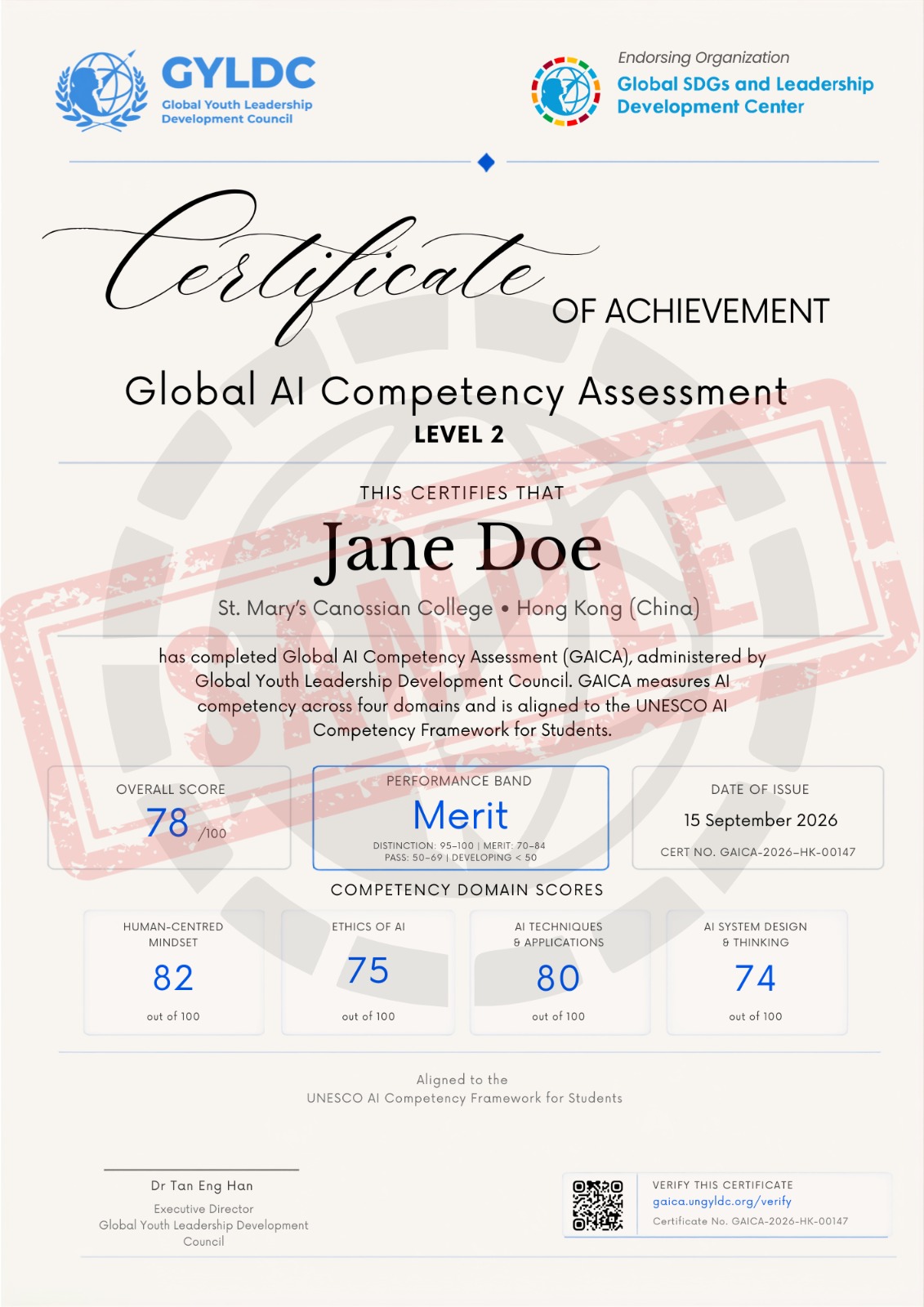
GAICA score certificate preview
GYLDC Advisory Board
Bhaskar Pant

Bhaskar Pant

Executive Director, MIT Professional Education
Board of Advisors, GYLDC

Simmy Ziv-el

Simmy Ziv-el

Former Chief Strategy Officer, FineTune by Prometric
Board of Advisors, GYLDC

Dr Serge Stinckwich

Dr Serge Stinckwich

Research Fellow, United Nations University Paris
Academic Expert, GAICA

Become a Founding GAICA School in Hong Kong

Bring a globally recognised AI credential to your students

  • Students earn a globally recognised GAICA competency certificate
  • School receives class and grade-level benchmarking reports
  • Your school is named a Founding GAICA School in Hong Kong
 

Delivery

Online • Paper-Based • Hybrid

Frequently Asked Questions

Everything you need to know about GAICA

Explore the most common questions about assessment levels, scoring, fees, preparation, school reporting, and language availability.

10 Common Questions
01 How will GAICA benefit me or my school?
  • Students: Receive an internationally recognised, UNESCO-aligned credential that benchmarks AI competency. For Level 3 students, it can support university and scholarship applications.
  • Schools: Gain a structured way to measure AI literacy, supported by class and school-level benchmarking reports.
  • Families: Receive clear, personalised insight into a child’s AI readiness through the individual student report and domain score breakdown.
02 Which level should I choose?

Levels are matched to grade band and prior GAICA experience:

  • Level 1 — Understand: Grades 3–6, for students beginning to learn about AI.
  • Level 2 — Apply: Grades 7–9, or Level 1 graduates ready to move from knowing about AI to applying it.
  • Level 3 — Create: Grades 10–12, or Level 2 graduates who scored Pass or above and are ready for IB, A-level, or pre-university-level rigour.
03 What does GAICA actually assess?

Every level assesses four domains: Human-Centred Mindset, Ethics of AI, AI Techniques & Applications, and AI System Design & Thinking.

04 How long is the assessment, and how many questions are there?
  • Level 1: 45 questions, 60 minutes.
  • Level 2: 50 questions, 75 minutes.
  • Level 3: 50 questions plus tasks, 90 minutes.
All assessments are in English at CEFR A2–B1 and are available in paper-based, computer-based, or hybrid formats.
05 How is the assessment scored?

Four performance bands apply at every level: Distinction (85–100), Merit (70–84), Pass (50–69), and Developing (below 50).

06 What do students and schools receive after the assessment?

Participants receive a personalised certificate and domain score profile. Schools also receive a school summary report and class performance report. Certificate authenticity can be verified using its QR code.

07 How much does it cost, and what is included?

For the 2026 assessment year, ASEAN-rate fees are USD 72 for Level 1, USD 82 for Level 2, and USD 92 for Level 3.

  • The assessment and score certificate.
  • Test-taker Guidebook.
  • Individual Student Report.
  • Two online AI Competency Development sessions, subject to pre-booking and availability.
Groups of 10 or more students receive a 10% discount. LDC rates are available for eligible students from UN-listed Least Developed Countries. Fees are non-refundable after assessment access. Bank transfer and major credit cards are accepted.
08 Is financial assistance available?

Yes. The GAICA Scholarship Programme is open to individual students with demonstrated financial need, schools in underserved communities, and educators supporting disadvantaged students.

09 What preparation resources are available?

Each level has a dedicated Study Textbook covering all four domains with case studies and practice questions. For schools managing multiple students, Levels 2 and 3 include a School Report Suite, while Level 1 includes a School Administration Pack.

10 Is GAICA available in languages other than English?

GAICA is currently available in English only. Localised Simplified Chinese and Bahasa Indonesia versions are planned for release in Q3 2027.

GAICA — Global AI Competency Assessment. Regional Partner: The Experiential Labs.
Enroll Program

Enroll in our program to unlock expert knowledge, hands-on training, and personalized support.